
How Many Porta Potties Do I Need for a Construction Site?
Start with the OSHA table. Under 1926.51(c), a crew of 20 or fewer needs one toilet facility. Once you pass 20 workers, the rule adds a toilet seat and a urinal for every 40 workers, and that ratio holds until you reach 200 workers, where it drops to one seat and one urinal per 50. A 35-person framing crew in Tracy, for example, lands in the 20-to-199 bracket, so two combination units cover it with room to spare. Bigger crews should run the math per shift, not per total headcount, since a swing shift halves the number on site at once. If you are staging a bigger build near Mountain House, 7.8 miles northwest, or coordinating a multi-site job that reaches Lathrop, the crew count per site is what drives the order, not the job total. Most contractors book standard porta potty rental units for this, and pair them with a handwashing station rental to cover general sanitation needs under the same 1926.51(c) framework. Painting, coating or pesticide crews trigger a separate rule, 1926.51(f)(1), which requires washing facilities specifically for those contaminants, so flag that scope early with your request a quote form.
How Many Porta Potties Do I Need for an Event?
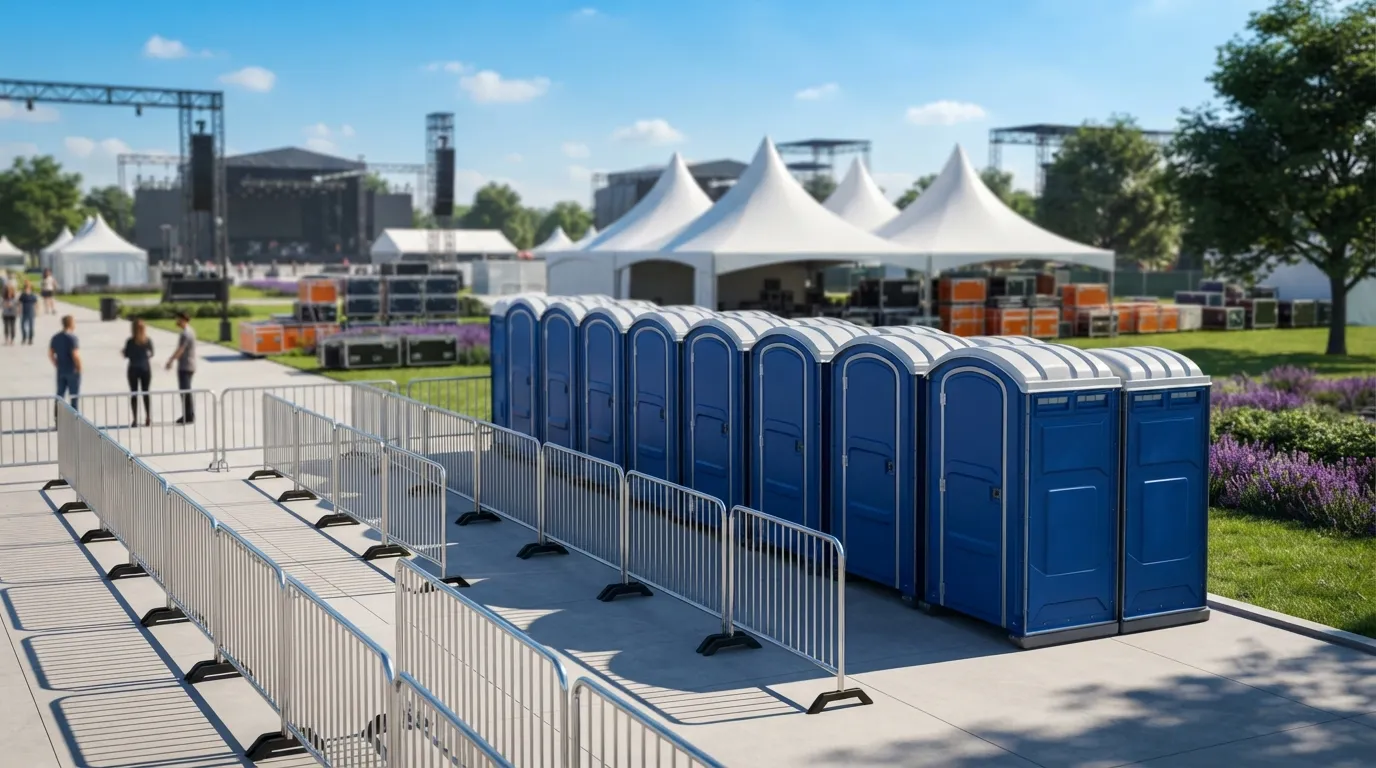
Guest count and hours both matter more than square footage. A useful starting ratio is one standard unit per 50 guests for a 4 hour event; stretch the event to 8 hours and that ratio tightens, because each unit sees roughly double the visits. A 400-person backyard wedding running 5 hours, for instance, comfortably clears with 8 to 10 standard units, and swapping a couple for deluxe flushable porta potty units near the ceremony area upgrades the guest experience without changing the math much. If alcohol is served, bump your count up by roughly 20 to 30 percent, since drinking events see more frequent, shorter visits per person. Multi-day festivals need a servicing plan on top of unit count. ANSI/PSAI Z4.3 sets a baseline service interval of once per week for up to 10 users across a 40 hour week, which is a light-duty guideline; a weekend festival with thousands of guests needs far more frequent pumping than that baseline implies. Check the festival restroom rental and county fair restrooms pages for higher-volume planning, and use event restroom rental for the general framework.
What Ratio Should I Use for a Wedding or Private Party?
One unit per 50 guests per 4 hours is the safe starting ratio for a seated wedding or backyard party in Tracy. A 150-guest reception running 6 hours should plan for at least 4 to 5 standard units, and one of those should be an ADA-compliant unit under ADA Standards section 213.2, which requires at least one accessible unit whenever single-user units are clustered, regardless of total count. Add a sink if the caterer is serving food outdoors; a portable sink rental satisfies 29 CFR 1910.141(d)(2), which requires soap and towels or a hand-drying device at any washing station, since hand sanitizer alone does not meet that standard. Couples planning a reception near Tracy often check wedding restroom rental for staging tips, and pair units with light for evening events through light tower rental if the reception runs past dusk.
Does Alcohol Change the Porta Potty Count?
Yes. Alcohol service shortens the interval between visits, so a straight headcount ratio undercounts the real need. Add 20 to 30 percent more standard units, or add a couple of extra ADA units if the crowd skews toward standing and drinking rather than seated dining. A 300-person concert with a beer garden, running 6 hours, might otherwise call for 6 units under the plain guest ratio, but with alcohol factored in that climbs closer to 8. Concerts and festivals in Tracy that expect heavy drinking traffic should look at concert restroom rental and consider a deluxe flushable porta potty mix near the bar tents, since flush units handle higher-frequency use better than standard tanks on peak nights.
How Do Multi-Day Events Change the Count?
Multi-day events need more units per guest than single-day events, because tanks fill and servicing crews cannot always reach every unit daily. A 60 to 70 gallon holding tank on a standard unit handles a single busy day fine, but three days of continuous festival traffic without a mid-event pump-out risks overflow. Plan either a higher unit count to spread the load, or schedule a servicing pass partway through, similar to the weekly baseline set by ANSI/PSAI Z4.3 for lighter-duty settings. A three-day county fair drawing 2,000 daily guests, for example, needs both a larger fleet and a standing servicing schedule, not a one-time drop. Multi-day builds should also plan around porta potty placement guide basics, since units need to sit on stable, level ground per ADA Standards section 302.1 if any accessible units are on site, and that surface requirement gets harder to hold on unpaved festival grounds after a few days of traffic.
What Size Roll-Off Dumpster Do I Need Alongside My Restrooms?
Match the dumpster to the debris type, not just the headcount. A 10 yard dumpster runs about 10 feet long, roughly 10 by 8 by 4 feet, offering roughly 320 cubic feet of capacity, right for a small bathroom remodel or a single day of event teardown. A 20 yard dumpster runs about 22 feet long and holds roughly 640 cubic feet, carrying up to 2 to 3 tons on a typical construction debris load, which fits a mid-size renovation. Step up to a 30 yard dumpster and you are looking at roughly 960 cubic feet, rated for up to about 4 tons depending on material density, right for a home addition or a multi-unit cleanout. A 40 yard dumpster tops out near 1,280 cubic feet, so if you are asking how many cubic feet are in a 40 yard dumpster, that is the number, and it can carry up to roughly 5 tons of lighter debris like framing scrap, though dense material like concrete or shingles will hit the weight cap long before the box fills. Check dumpster sizes and dimensions for a full breakdown, and confirm your load type against dumpster weight limits before you order, since overloaded boxes carry extra fees. Roll-off trucks need about 60 feet of straight clearance behind the drop point, so measure your Tracy driveway or job entrance before delivery day and pair the box with a roll-off dumpster rental or a size-specific page like 20 yard dumpster rental or 30 yard dumpster rental.
Where Does Placement Fit Into the Count?
Placement can quietly force you to add units even when your ratio math says you have enough. Units need a clear, stable path for guests and workers, and any accessible unit needs the 60 inch turning circle described in ADA Standards section 304.3.1 plus a 36 inch clear route under section 403.5.1. If your event spreads across a large field or a multi-building jobsite, one cluster of units in the wrong spot means half your guests or crew walk further than they should, which drives up per-unit traffic and effectively lowers your real capacity. Spreading units into two or three smaller clusters instead of one big bank usually solves this without adding to the total count. See porta potty placement guide for layout specifics, and if you are running power to a jobsite bank of units after dark, temporary power pole service pairs well with light tower rental for visibility.
Every job in Tracy is different, and the numbers above are starting ratios, not guarantees. Tracy Porta Pros will walk your headcount, hours and site layout with you before quoting a final unit count. Compare your options on the porta potty rental cost page or start with how many porta potties do i need as a baseline before requesting a porta potty rental quote.
How many porta potties do I need for 100 people?
For a 4 hour event, plan on 2 standard units per 100 guests, using the one-per-50 ratio. Stretch the event past 4 hours, or add alcohol, and you should push closer to 3 units to keep wait times reasonable throughout the day.
How many tons does a 30 yard dumpster hold?
A 30 yard dumpster generally carries up to about 4 tons, though the real cap depends on material density. Concrete or dirt hits the weight limit fast; lighter framing debris fills the cubic footage before it hits that weight cap.
How many tons does a 40 yard dumpster hold?
A 40 yard dumpster can carry up to roughly 5 tons of lighter debris like framing scrap, though dense loads like concrete or shingles hit the weight cap long before the 1,280 cubic foot box fills up.
How many tons does a 20 yard dumpster hold?
A 20 yard dumpster carries up to 2 to 3 tons on a typical construction debris load, depending on how dense the material is. Mixed renovation debris usually fills the box before it hits that weight cap.
How many feet is a 10 yard dumpster?
A 10 yard dumpster runs about 10 feet long, 8 feet wide and 4 feet tall, which works out to roughly 320 cubic feet. That size suits a small bathroom remodel or a single day of event teardown.
How many cubic feet are in a 20 yard dumpster?
A 20 yard dumpster holds roughly 640 cubic feet, in a box that runs about 22 feet long. That size handles a mid-size renovation or a moderate cleanout without needing a second pull.
Do I need an ADA porta potty on a jobsite?
Yes, if you are clustering single-user units. ADA Standards section 213.2 requires at least 5 percent of clustered units to be accessible, and never fewer than one, regardless of how small the cluster is.
How often do porta potties need servicing at a multi-day event?
ANSI/PSAI Z4.3 sets a baseline of one service visit per week for up to 10 users across a 40 hour week, which is a light-duty guideline. High-traffic, multi-day events need far more frequent servicing than that baseline.
What happens if I underestimate my headcount?
Lines back up fast, and unit tanks fill faster than expected, risking overflow before your event ends. It is safer to round up your count slightly, especially with alcohol service or hot weather driving more frequent restroom visits.
Next step
Get a delivery date
Tell us the address, the dates and the headcount. We size the order and confirm the route.